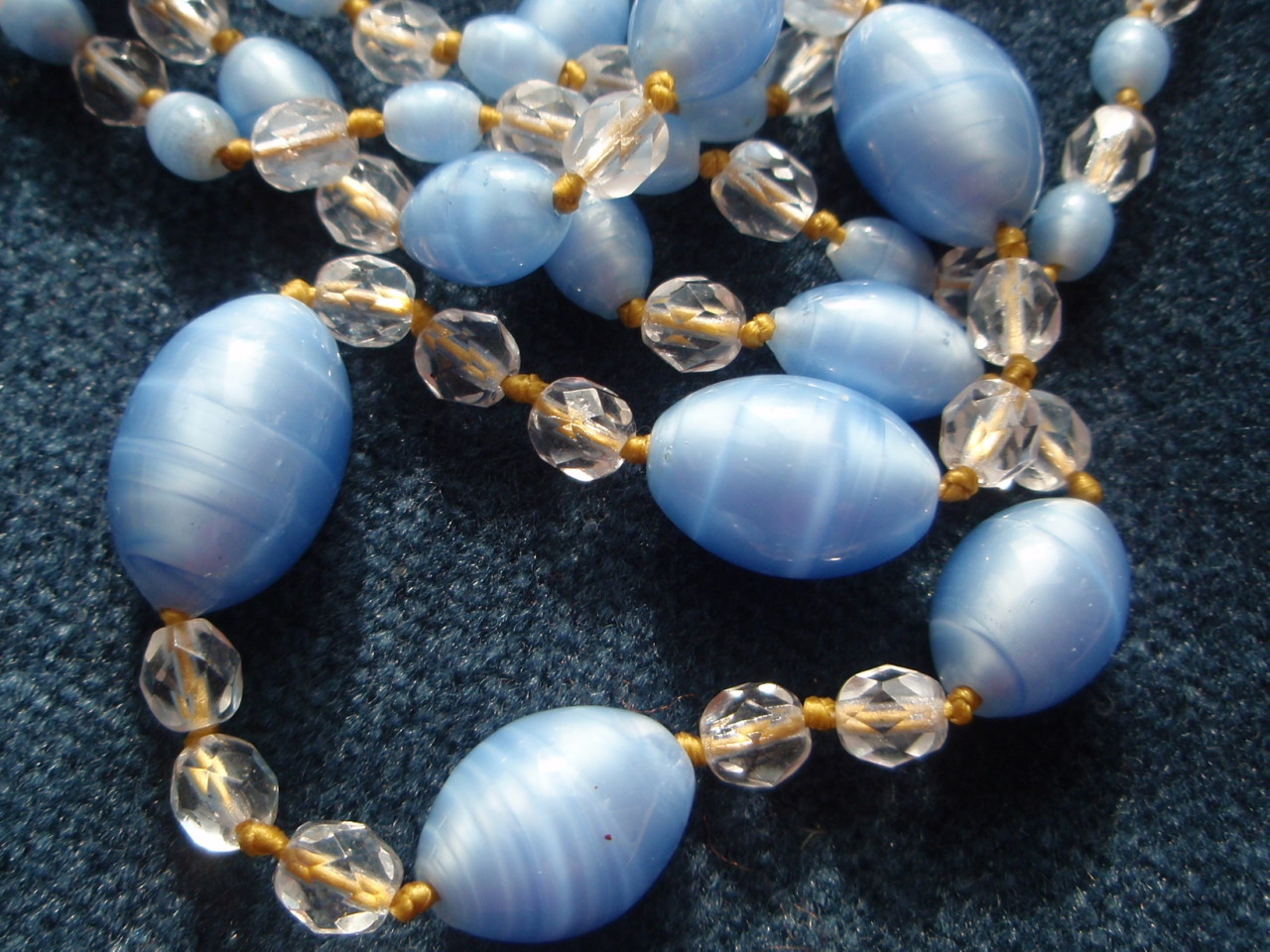
Genuine vintage Czechoslovakian jewellery has a huge number of admirers and collectors worldwide. Nothing looks so good on a vintage summer dress than a perfect Bohemian brooch or string of Czech crystal beads. Or perhaps one of the increasingly rare pieces as shown above and below (from my personal collection).
About twenty years ago, it was obvious what was genuinely vintage Czechoslovakian (more correctly called Bohemian), for it is almost instantly recognizable at a glance, or rather used to be.
 In case anyone still thinks that genuine Bohemian crystal necklaces come in only topaz or dark topaz, I am including some of my rarer pieces to make my point.
It used to be that antique dealers of 'smalls' (ie small items including jewellery) used to derisively refer to Bohemian crystal as 'brass and glass'. They soon changed their tune when these pieces started fetching more than three figures in auctions.

Now the waters are rather ‘muddied’ with a whole bunch of 'crafters', buying vintage Czech findings (the metal parts) and the stones, and making up what most of them are calling ‘genuine vintage Czech’ jewellery.

I call these 'wannabe' items Frankenstein Fakes. They are a hybrid, and again at a glance, it is often easy to detect them, if you are experienced, or follow a few guidelines.

The biggest giveaway that they are fake vintage, is that they often have asymmetrical (or unequal) dangles, and the motifs are more Chinese than Czech, with many over-embellished dragons and butterflies. Here is a classic example of a Frankenstein Fake :

THIS IMAGE ABOVE IS OF A FRANKENSTEIN FAKE
Note the sideways on butterfly, the awful unbalanced design with the massive pink crystal dumped at the end of a wayward and misbegotten necklace.
Whilst the seller claims that the findings come from a deserted warehouse in what is now the Czech republic, ALL of these elements, the beads, the metal parts, the chains and the crystals are ALL available to buy and the leading seller is the big bad EBAY.

If something is branded as Rolex or Gucci, Ebay are almost compelled to take action against fakes rather than face years and millions in legal costs.

With Bohemain fakes, and unscrupulous sellers, there is no one left to defend the intellectual or design rights for the unsung Bohemian craftsmen of past centuries.

But of course, there is nothing wrong with crafters making their own versions of ‘Czech’ jewellery, with vintage components, often bought from newly discovered old stock. But to name them genuine vintage Czech is misleading and inaccurate, but of very difficult to prove, if the seller refuses to be honest or has been mislead themselves.
Another way of spotting these fakes of the vintage jewellery world is the designs. They are very often miles away from 'classic' Czech and often combine motifs and colours which the Bohemian craftsmen of days gone by would never ever have used.

THIS IMAGE ABOVE IS OF A FRANKENSTEIN FAKE
This hideous monstrosity shown above, with the profile of an Egyptian and the head below it, is a classic example of fake overkill. Presumably the seller has realized that genuine Egyptian pieces of Bohemian origin, produced around the time of the discovery of the tomb of King Tut do command high prices.
But not in a Bohemians worst nightmares would an Egyptian inspired necklace ever have looked like this.
This seller claims "Items are recently imported from Czechoslovakia, they were made between 1915 and 1930 by the Gablonz Jewelry Company."
Whether this seller is being ignorant or deceptive is hard to tell. But at present she (based in the USA) has more than thirty of these Frankenstein Fakes up for sale.
I have now posted two images as examples of Frankentstein Fakes, all in a small size. ALL of the other examples are from Bohemia and all of them are from my personal collection. There are plenty more which will be photographed and added here over time. And yes, some do feature butterflies and Egyptian themes.
In the interests of balance, I should say that there is only one example I have ever seen, which really did look like an original old Bohemian necklace but the seller was upfront and honest about the genesis of the necklace. Had she not been, I would have been hard pushed to tell the difference at first glance.
The style was correct, the colour was correct, and the materials were correct. The only giveaways were that the clasp was modern gold plated, a spring ring, and rather small for the size and weight of the necklace. Another clue was that the thread used was modern 'tiger -tail'.
But how is a novice collector, who maybe was not around twenty years ago, or who only just discovered the wonder of Bohemia and Czech jewellery to know what is genuine and what is simply fake?
There are very few books on the market detailing the production of Czech jewellery. Those I have are extremely interesting, and detail just how the artisans of Bohemia missed out big-time on being recognised for what they were, pioneers and craftsmen of great worth to the vintage costume jewellery business. In my view, the author is very methodical but is not a native English speaker, so much of the facts come over as garbled.
But how is a novice collector, who maybe was not around twenty years ago, or who only just discovered the wonder of Bohemia and Czech jewellery to know what is genuine and what is simply fake?
There are very few books on the market detailing the production of Czech jewellery. Those I have are extremely interesting, and detail just how the artisans of Bohemia missed out big-time on being recognised for what they were, pioneers and craftsmen of great worth to the vintage costume jewellery business. In my view, the author is very methodical but is not a native English speaker, so much of the facts come over as garbled.
There are other ways that Bohemian or Czech vintage costume jewellery is faked, and that she be the subject of my next post.
Just be warned and AVOID any glitzy over the top jewellery which is stamped 'Lillien' especially if they are being sold by someone who lives in France.